

If you feel like work has slowly taken over everything else in your life, you are not imagining it. And you are definitely not alone.
In 2026, the boundaries between professional and personal life have never been more blurred. Remote work normalized the always-on culture. AI tools increased output expectations. Economic pressures pushed many people to work longer hours just to feel secure. The result? A workforce running on empty.
Here is the number that stopped me cold: 60% of U.S. workers report having no clear boundaries between their work responsibilities and their personal lives, according to recent SurveyMonkey research. Six out of ten people cannot tell where work ends and life begins. That is not a productivity problem. That is a crisis.
But here is the good news. Work-life balance is not a myth, and it is not reserved for people with flexible jobs or unlimited vacation days. It is a skill. It is a set of daily decisions, boundaries, and habits that anyone can build — regardless of their role or industry.
This guide gives you the most practical, research-backed work life balance tips for 2026: strategies that account for the real pressures workers face today, including AI-driven workloads, hybrid schedules, economic anxiety, and the creeping expectation to always be available.
Whether you are an employee, a manager, a freelancer, or a remote worker, there is something in here for you.
Why Work-Life Balance Matters More Than Ever in 2026

Before diving into the tips, it is worth understanding why this conversation has become so urgent right now.
The pandemic changed work permanently. Remote and hybrid models expanded. Digital communication tools multiplied. And with them came a subtle but powerful shift: the workday no longer has a natural ending.
83% of workers now say work-life balance is the most important factor when choosing a job — ranking above pay for the first time in recorded survey history. That statistic alone tells you everything about the moment we are in.
The health consequences are equally stark. 77% of employees say work stress harms their physical health. According to a 2026 report by Wellhub, 90% of employees experienced burnout symptoms in the past year. And Microsoft’s Work Trend Index found that 40% of employees check email before 6 a.m. — not because of deadlines, but because of ambient anxiety.
This is the environment in which people are trying to live full, meaningful lives.
The Cost of Ignoring Balance
Poor work-life balance is not just a personal inconvenience. It carries measurable costs for both individuals and organizations.
- Burnout is the top reason HR professionals cite for employee turnover, according to SurveyMonkey’s 2025 Workplace Culture report.
- Chronic overwork raises the risk of coronary heart disease and stroke, according to large-scale meta-analysis research.
- 44% of employees have left a job because of a toxic culture — one where work devoured personal time and wellbeing was ignored.
The message is clear: balance is not a luxury. It is a survival strategy.
Understanding What Work-Life Balance Actually Means in 2026
The old definition of work-life balance — leave the office at 5 p.m. and do not think about work until morning — no longer fits most people’s reality.
Today, the concept is more nuanced. Researchers and workplace experts increasingly distinguish between two models:
Work-life balance emphasizes intentional separation between professional and personal time. You work defined hours and protect personal time with clear limits.
Work-life integration blends work and personal activities fluidly throughout the day — attending a child’s school event midday, then catching up on work later. This model suits freelancers, remote workers with family responsibilities, or anyone whose schedule resists rigid structure.
Neither approach is universally better. What matters is that you choose your model intentionally, rather than letting work expand to fill every available hour by default.
In 2026, the most resilient workers have stopped asking “how do I keep work from taking over?” and started asking a sharper question: “How do I design a working life that is sustainable for the long run?”
The 10 Most Effective Work Life Balance Tips for 2026
1. Set a Hard Boundary for Your Workday End Time
This sounds obvious. It is surprisingly hard to do in practice.
The always-on culture has taught many workers that availability equals commitment. Responding to a message at 9 p.m. signals dedication. Not responding signals laziness. This is a harmful myth — but it persists because leaders model it.
Setting a firm end time for your workday — and actually honoring it — is one of the highest-leverage changes you can make.
Here is how to make it stick:
- Choose a consistent end time and put it in your calendar as a recurring block.
- Set a “shutdown ritual” — a five-minute routine that signals to your brain that work is done. This might be closing all tabs, writing a brief to-do list for tomorrow, or a short walk around the block.
- Turn off work notifications on your phone after that time.
- Communicate your boundaries to colleagues clearly and professionally.
Research consistently shows that shutdown rituals reduce cognitive intrusion — the experience of thinking about work when you are trying to be present elsewhere.
2. Use AI Tools to Protect Your Time, Not Just Fill It
AI has transformed work in 2026. But its impact on work-life balance is complicated.
On one hand, AI tools can automate repetitive tasks, analyze workloads, and free up hours of mental energy. On the other hand, research from Randstad’s 2026 AI Reality Gap report found that nearly half of workers fear AI benefits the company’s output more than their personal balance.
The key is being intentional about how you use AI.
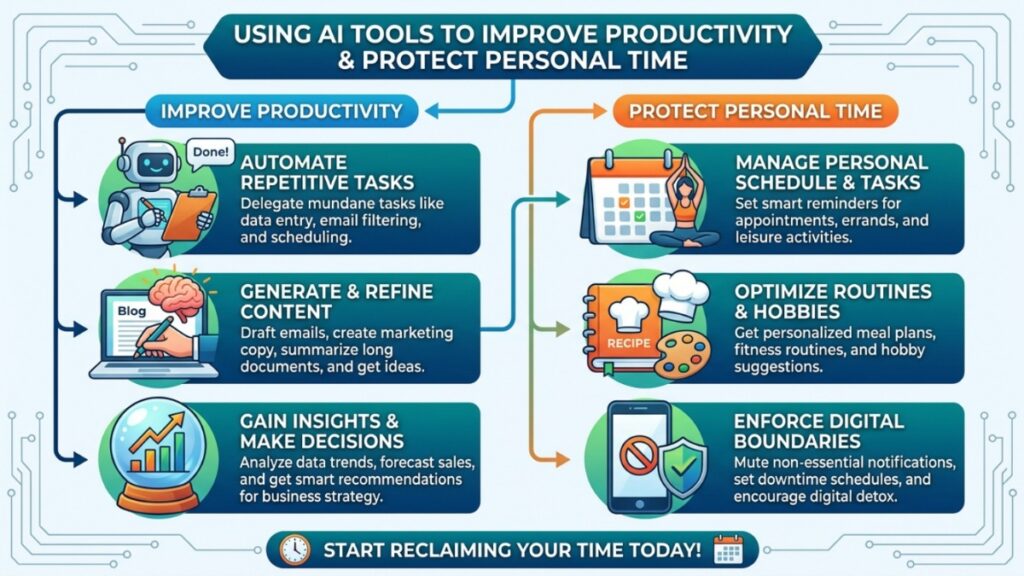
AI can help your balance when used to:
- Automate scheduling and reduce calendar back-and-forth
- Draft routine communications so you can batch-review them in less time
- Block focus time automatically based on your energy patterns
- Filter non-urgent notifications so they do not interrupt personal hours
- Analyze your workload distribution and flag when you are overloaded
AI may hurt your balance when it:
- Increases output expectations without adjusting workload
- Adds review layers that consume the time it was supposed to save
- Generates a constant stream of tasks requiring human approval
Use AI as a tool for subtraction, not just acceleration. The goal is fewer decisions, less cognitive load, and more protected personal time.
3. Redesign Your Physical Workspace (Even at Home)
Where you work shapes how you feel about work.
One of the most effective work-life balance tips that gets overlooked is the role of physical environment. When your home office is also your dining table — or worse, your bed — your brain struggles to shift out of work mode because the physical cues are absent.
If you work from home, create distinct spatial boundaries:
- Designate a specific spot for work, even in a small apartment.
- When work ends, close the laptop. Physically move it out of sight if possible.
- Avoid working from your bedroom. Sleep science is clear: associating your sleep space with work degrades sleep quality.
- Consider a “transition ritual” that replaces the old commute — a 10-minute walk, a change of clothes, or making a cup of tea in a deliberate, screen-free way.
For hybrid workers, the commute days can paradoxically help restore balance by creating natural transitions. Use those in-person days intentionally.
4. Audit Your Time Honestly Before Trying to “Fix” It

Most people dramatically misestimate where their time goes. Before implementing any strategy, spend one week tracking your actual hours.
You do not need a sophisticated app. A simple spreadsheet or notepad works.
Track three things:
- Hours actually worked (not hours at a desk or on a device)
- Where attention leaks (meetings that run long, reactive email checking, context-switching)
- What personal time actually looks like (are you really resting, or just doomscrolling?)
What this audit usually reveals is not that you need more hours — it is that the hours you already have are being spent inefficiently or unconsciously.
From this data, you can make targeted changes instead of broad, unsustainable overhauls.
5. Protect Your Non-Negotiables
Every sustainable work-life balance strategy is built around a small set of personal anchors — activities so important to your wellbeing that missing them consistently leads to deterioration.
These are your non-negotiables.
They are different for everyone. For some people, it is exercising before work. For others, it is having dinner with family five nights a week, or a standing weekly call with a close friend, or eight hours of sleep.
The mistake most people make is treating non-negotiables as optional — something to do “if there is time.” Time never appears on its own. It gets scheduled, or it disappears.
Practical steps:
- Identify your top three to five personal non-negotiables.
- Block them in your calendar before anything else.
- Treat them with the same seriousness as a client meeting.
When someone asks you to schedule something during a non-negotiable block, that block is already taken. You do not owe an elaborate explanation.
6. Learn to Manage Energy, Not Just Time
Time management advice often misses a fundamental truth: an hour at peak energy is worth three hours when you are depleted.
Energy management means understanding your own rhythms — when you do your best thinking, when your focus dips, and how to structure your day accordingly.
Most people have a two-to-three-hour window of peak cognitive performance, typically in the morning (though this varies significantly by individual). Guard that window fiercely.
An energy-conscious day might look like:
| Time | Activity |
|---|---|
| 8–10 a.m. | Deep work (creative, complex, high-stakes tasks) |
| 10–11 a.m. | Collaborative work, team check-ins |
| 11 a.m.–12 p.m. | Emails, admin, routine communication |
| 1–2 p.m. | Light tasks (post-lunch dip is real) |
| 2–4 p.m. | Focused work resumes for many people |
| 4–5 p.m. | Planning, wrap-up, review tomorrow’s priorities |
Protecting your peak hours from meetings and reactive tasks is one of the highest-leverage changes you can make to both productivity and personal wellbeing.
7. Set Communication Expectations With Your Team
Individual boundary-setting only works if your workplace culture supports it. And culture flows from explicit norms — agreements your team actually discusses and honors.
If your team culture assumes instant responses to messages at any hour, your personal boundaries will constantly be tested.
Consider establishing team norms around:
- Response time expectations (for example: all messages answered within four hours during business hours, non-urgent messages not expected to be answered after 6 p.m.)
- Meeting-free days or blocks (many high-performing teams protect at least one day a week)
- Email or Slack etiquette (leading with “no reply needed until Monday” when sending weekend messages)
- Clear escalation paths for genuine emergencies, so everything else stops being treated as one
If you are a manager, your behavior here is disproportionately influential. When you send emails at 11 p.m., your team feels implicitly pressured to respond — even if you explicitly tell them they do not have to.
8. Take Your Vacation Days — All of Them
Untaken vacation is a widespread problem, particularly in the United States, United Kingdom, and high-pressure industries. Many workers feel guilty taking time off, worry about falling behind, or lack the psychological safety to fully disconnect.
The research is unambiguous: workers who take their full vacation days are more productive, more engaged, and less likely to burn out over the long term.
A few things that make vacation actually restorative:
- Plan coverage before you leave, so you do not spend your vacation managing worries about work.
- Set an out-of-office message and stick to it.
- Resist checking email “just once.” That single check reactivates your stress response and undermines recovery.
- Return to work with a light first day back — a buffer day of catching up before diving into demanding tasks.
If a week feels impossible, start smaller. A long weekend with genuine disconnection is far more restorative than a week where you check in twice a day.
9. Invest in Recovery, Not Just Productivity
The work-life balance conversation focuses heavily on what to cut from work. But equally important is what to build into your personal life that actively restores you.
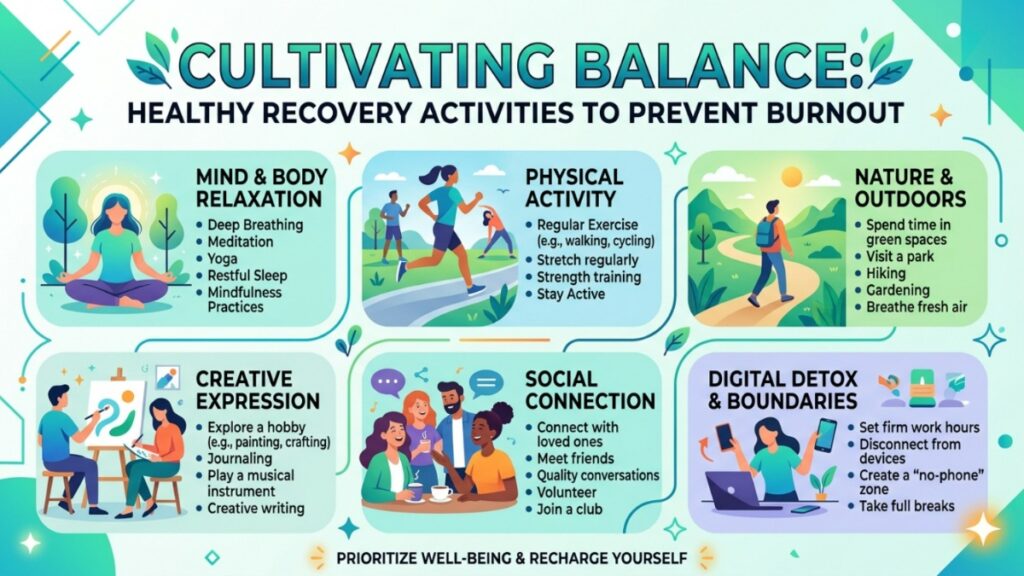
Recovery is not the absence of work. It is the presence of activities that replenish cognitive, emotional, and physical resources.
Research on recovery science identifies four key experiences that restore depleted workers:
- Psychological detachment: mentally disengaging from work during off-hours
- Relaxation: activities with low demands that allow your nervous system to downregulate
- Mastery: pursuing something outside work where you grow and feel competent
- Control: having autonomy over how you spend your personal time
Many workers fill their evenings with passive scrolling — which feels like rest but does not deliver genuine recovery. Swapping even 30 minutes of that for an absorbing hobby, social connection, physical movement, or time in nature produces measurably better restoration.
10. Talk to Your Manager If Balance Feels Impossible
If you have implemented personal strategies and still feel chronically overloaded, the issue may be structural — too much work for one person to reasonably do in a reasonable number of hours.
That is a conversation worth having, even if it feels uncomfortable.
When framing this conversation:
- Come with data. Track your hours and tasks for two weeks before the meeting.
- Focus on impact, not complaint. Explain how the current workload affects output quality, not just how it makes you feel.
- Propose solutions. Come with options — reprioritization, delegation, additional resources, or clearer expectations about what can wait.
According to SurveyMonkey’s workplace research, 78% of workers say their job provides a healthy work-life balance. That means most managers, when approached directly and professionally, are willing to work toward solutions.
Work-Life Balance for Specific Situations
For Remote Workers
Remote work removed the commute but created a new problem: without physical separation between work and home, psychological separation requires deliberate effort.
Key strategies for remote workers:
- Create a defined workspace, even if space is limited.
- Keep consistent start and end times.
- Use your former commute time intentionally — exercise, reading, or simply sitting quietly before work begins.
- Over-communicate your availability hours to avoid assuming colleagues expect constant access.
For Working Parents
Parents face a particular version of the balance challenge: they are juggling two full-time roles with no official transition time between them.
What helps:
- Accept imperfection. Balance looks different week to week, and that is normal.
- Protect anchors that matter most — school pickup, bedtime routines — as non-negotiables.
- Use asynchronous communication wherever possible to give yourself scheduling flexibility.
- Share the mental load with your partner if you have one. Division of domestic responsibilities is inseparable from professional balance.
For High-Achievers and Managers
People who are driven, ambitious, and in leadership roles often have the hardest time with balance — because they genuinely love their work, or because they feel responsible for their team in ways that make full disconnection feel irresponsible.
For this group, the work is less about setting limits and more about redefining what excellence looks like.
Sustainable high performance is not about working the most hours. It is about making the right decisions at the right time with a clear head. That requires recovery.
Modeling good boundaries as a leader also gives your team permission to do the same — which reduces their burnout risk and increases retention.
What Companies Can Do to Support Balance
Work-life balance is not only an individual responsibility. Organizations have significant power to create cultures where it is genuinely possible.
The most effective organizational practices include:
- Flexible scheduling: allowing employees to shape their hours around personal needs, not just business hours
- Mental health benefits: paid mental health days, therapy stipends, or employee assistance programs
- Reasonable workloads: actively monitoring whether teams have the capacity to deliver without chronic overtime
- Cultural modeling: leaders who take vacation, leave on time, and discourage after-hours messages set powerful norms
- Psychological safety: an environment where raising workload concerns does not feel career-threatening
Organizations that support balance report lower turnover, higher productivity, and stronger talent attraction. The business case is clear and well-documented.
A Practical Work-Life Balance Checklist for 2026
Use this checklist to assess where you stand today and identify your first priority:
- [ ] I have a consistent, respected end time for my workday
- [ ] I have a shutdown ritual that signals the transition from work to personal time
- [ ] My top three personal non-negotiables are scheduled and protected
- [ ] I take all of my allocated vacation days each year
- [ ] My workspace has physical boundaries that support mental transition
- [ ] I know my peak energy hours and protect them for deep work
- [ ] My team has explicit norms around communication and after-hours availability
- [ ] I engage in at least one genuinely restorative activity daily
- [ ] I use AI and digital tools to protect time, not just produce more output
- [ ] I have had, or am willing to have, a direct conversation if workload is unsustainable
If you checked fewer than five boxes, you have clear opportunities to act on. Start with one — not all ten at once.
Conclusion
Work-life balance in 2026 is not about achieving some perfect equilibrium every day. It is about building a life where work is a meaningful part — not the whole thing.
The work life balance tips in this guide are not radical. They are practical, grounded in current research, and adaptable to real-world constraints. What makes them effective is not their sophistication. It is consistency.
Start with one boundary. Protect one non-negotiable. End work one hour earlier for one week. Notice what changes.
The data is clear: workers who invest in their balance are healthier, more productive, and more sustainable in their careers over the long term. That is not idealism — it is evidence.
Now it is your turn to put it into practice. If something in this guide resonated with you, share it with a colleague or leave a comment below. Sometimes the first step toward balance is simply knowing you are not navigating it alone.
This article is updated regularly to reflect current workplace research and trends. The information provided is for educational and informational purposes. For mental health concerns related to burnout or chronic stress, we encourage you to consult a qualified healthcare or mental health professional.
Frequently Asked Questions About Work-Life Balance in 2026
What does work-life balance mean in 2026?
Work-life balance in 2026 refers to the intentional management of time, energy, and boundaries between professional responsibilities and personal life. Given the rise of remote work and always-on digital communication, it now requires more deliberate effort than in previous decades. Many experts also discuss work-life integration as an alternative model for those whose schedules are more fluid.
Why is work-life balance so hard to achieve right now?
Several converging factors make balance especially difficult in 2026: the normalization of remote and hybrid work, economic pressures pushing longer hours, AI-driven productivity expectations, and digital tools that make it possible to work anywhere at any time. Research shows that 60% of U.S. workers currently have no clear boundary between work and personal life.
What are the best work-life balance tips for remote workers?
Remote workers benefit most from creating a defined physical workspace, maintaining consistent daily start and end times, establishing a transition ritual to replace the commute, and setting explicit communication availability hours with their team. Psychological detachment — mentally switching off from work thoughts — is the single most researched predictor of remote worker wellbeing.
How can AI help with work-life balance?
AI tools can support balance by automating repetitive tasks, managing scheduling, filtering non-urgent communications, and analyzing workload patterns to flag overload. However, AI can also increase output expectations and add review workload. The key is using AI intentionally to reduce cognitive load and protect personal time, not simply to produce more.
How do I set boundaries at work without damaging my career?
Frame boundaries in terms of performance and output, not personal preference. Communicate clearly and proactively, propose solutions rather than just problems, and model professionalism in how you disconnect. Research consistently shows that employees who maintain healthy limits are more productive and more valued — not less.
What is the fastest way to improve work-life balance?
The single fastest change most people can make is identifying and protecting their top three personal non-negotiables — the activities most essential to their wellbeing — and scheduling them before anything else. Treating these with the same commitment as professional obligations shifts balance almost immediately.
How do I know if my work-life balance is actually poor?
Common signs include chronic fatigue, difficulty sleeping, feeling unable to mentally disconnect from work, neglecting relationships or hobbies you care about, frequent irritability, and physical symptoms of stress. If work consistently interferes with sleep, health, or meaningful personal relationships, that is a reliable signal that rebalancing is needed.