

Have you ever reached the end of a workday feeling exhausted — yet somehow unable to point to what you actually accomplished? You are not alone. In a world where the average employee is interrupted every two minutes by emails, notifications, and impromptu meetings, the ability to manage time effectively has become the defining skill of the modern professional.
Time management is no longer just a soft skill listed on a résumé. In 2026, it is a strategic advantage — for individuals navigating hybrid work models, for teams scaling with AI, and for anyone who wants to build a life that feels intentional rather than reactive.
This guide covers everything you need to know about time management today: why traditional systems are failing most people, which modern frameworks actually work, how AI is reshaping the productivity landscape, and the practical habits that consistently separate high performers from the rest.
Whether you are a seasoned professional, a remote worker managing multiple time zones, or someone who simply wants to feel less overwhelmed, this is the comprehensive resource you have been looking for.
Why Most People Still Struggle With Time Management
The statistics are striking. Research consistently shows that only 18% of individuals use a formal time management system. The other 82% rely on informal lists, memory, or — frankly — hope.
That lack of structure has real consequences. The average employee dedicates 51% of their workday to tasks that add little to no measurable value. Interruptions alone consume more than seven hours of productive time per week — nearly one full workday lost to disruptions, every single week. Over a year, that adds up to roughly 365 hours. More than nine complete working weeks, gone.
The sources of these interruptions are predictable: email notifications, chat messages, colleague questions, and back-to-back meetings. But what makes interruptions so costly is not the distraction itself. It is the recovery time. Every disruption triggers a cognitive reset that takes far longer than the interruption lasted.
The Modern Productivity Paradox
Here is the painful irony: we have never had access to more productivity tools, apps, and systems than we do right now. Yet a 2024–2025 Gallup report on employee engagement shows that dedication to work among the US workforce has been at an all-time low for two consecutive years.
Similar findings from the Microsoft Work Trend Index 2025 suggest that employees continue to struggle with digital overload, constant interruptions, and fragmented attention across multiple workplace tools.
The problem is not a lack of tools. It is a lack of clarity — on priorities, on boundaries, and on what “being productive” actually means for each individual.
Effective time management begins by recognizing this paradox and deciding to approach it differently.
The Core Principles of Effective Time Management
Before diving into specific systems and tactics, it helps to understand the foundational principles that make any approach work. These principles hold true whether you are using a paper planner or an AI-powered scheduling assistant.
1. Clarity Before Speed
Most time management failures happen not because someone is lazy, but because they are busy doing the wrong things. Clarity about your actual goals — for the day, the week, the quarter — is the foundation of everything else.
Without it, you will always be productive in a way that feels busy but moves you nowhere meaningful.
2. Energy Management Over Time Management
Time is fixed. You have 24 hours in a day, and no system will change that. But your energy — cognitive, physical, and emotional — is variable. High performers do not just manage their schedules. They protect their peak energy hours and assign their most demanding work to those windows.
Trying to do deep creative work at 4 p.m. when your energy has been depleted all day is not a time management problem. It is an energy allocation problem.
3. Systems Beat Willpower
Relying on motivation or discipline alone is a losing strategy. The most effective people build systems that make the right behavior the default — time-blocked calendars, dedicated distraction-free environments, weekly review rituals. The system carries the load when willpower runs dry.
4. Protection Over Addition
Most productivity advice focuses on what to add to your routine. But subtraction is often more powerful. Eliminating low-value meetings, unsubscribing from unnecessary email threads, and saying no to tasks that do not align with your priorities creates more usable time than any new app or technique.
Top Time Management Frameworks That Work in 2026
Dozens of time management methodologies exist. Here are the most effective ones, with practical guidance on when and how to use each.
The Time Blocking Method
Time blocking means scheduling specific blocks of dedicated time for specific tasks — and treating those blocks like unmovable appointments. No multitasking. No open-ended “I will get to it eventually.” Each task has a designated slot.
Research consistently finds that workers who dedicate time to weekly planning see a 30% increase in overall efficiency. The practice of reviewing upcoming priorities, blocking time for focused work, and identifying potential conflicts before they arise creates a protective structure around productive hours.
How to start: At the end of each week, map out the following week in blocks of 60–90 minutes. Assign your most cognitively demanding work to your first two to three hours of the day, before your inbox takes over.
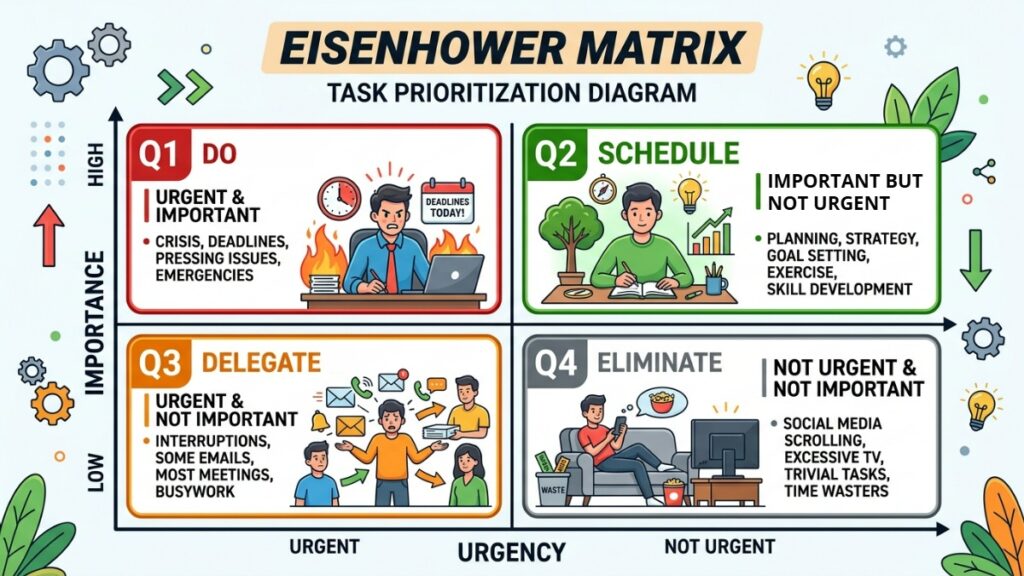
The Eisenhower Matrix
Developed from a principle attributed to President Dwight D. Eisenhower, this framework categorizes every task into one of four quadrants based on urgency and importance:
| Quadrant | Description | Action |
|---|---|---|
| Urgent + Important | Crises, deadlines | Do immediately |
| Not Urgent + Important | Strategic work, planning | Schedule dedicated time |
| Urgent + Not Important | Many emails, some meetings | Delegate if possible |
| Not Urgent + Not Important | Scrolling, busywork | Eliminate |
Most people spend the majority of their day in Quadrant 1 and Quadrant 3 — reacting to urgency without distinguishing what actually matters. The goal is to spend more time in Quadrant 2, where the highest-value, most strategic work lives.
The Pomodoro Technique
Originally developed in the late 1980s, the Pomodoro Technique remains one of the most practical tools for managing focus. The method is simple:
- Choose a single task to work on
- Set a timer for 25 minutes and work without any interruptions
- Take a 5-minute break
- After four cycles, take a longer 20–30 minute break

The value is in the constraint. Knowing that you only have 25 minutes before a break makes it easier to start, easier to focus, and easier to resist the pull of distractions.
It also makes large, daunting projects feel approachable. “Work on the quarterly report for 25 minutes” is far less intimidating than “write the quarterly report.”
Getting Things Done (GTD)
David Allen’s GTD system, first published in 2001, remains surprisingly relevant in 2026. Its core insight — that your mind is for having ideas, not holding them — is truer than ever in an era of information overload.
The system rests on five steps:
- Capture — collect everything on your mind into a single trusted inbox
- Clarify — process each item: what is it? Is it actionable?
- Organize — put things where they belong (calendar, project list, reference files)
- Reflect — review your lists regularly to stay current and on track
- Engage — work with confidence that you are doing the right thing at the right time
GTD works particularly well for people who manage complex, multi-threaded workloads — project managers, executives, and anyone juggling multiple roles simultaneously.
The 1-3-5 Rule
On any given day, aim to accomplish:
- 1 big task
- 3 medium tasks
- 5 small tasks
This simple framework fights two common failure modes: the unrealistic to-do list (10 or more items that can never realistically be completed) and the vague to-do list (“work on project X” with no sense of scope).
By capping yourself at nine items with clear size distinctions, you give yourself a realistic, achievable target for each day.
Time Management Challenges Specific to 2026
The modern work environment has introduced a new set of time management challenges that older frameworks were not designed to address.
The Hybrid Work Problem
Hybrid and remote work arrangements have blurred the lines between professional and personal time in ways that create new pressures. A recent study on email and work communications burnout found that 71.1% of American employees feel obligated to answer emails outside of working hours. Meanwhile, 55% of job seekers actively look for hybrid roles — suggesting that the flexibility is desired, but the boundaries around it are still being negotiated.
Effective time management in a hybrid context requires explicit boundary-setting: defined start and end times, designated communication windows, and clear agreements about what “off hours” means.
The Email Trap
Email is the single largest hidden drain on professional time. A 2025 survey found that 35% of workers spend between two and five hours each day managing email. One in four employees reports spending more than three-quarters of their workday on email alone.
The average professional checks their inbox approximately every 37 minutes — around 15 times per day. And 17% of Americans admit to checking their inboxes even during face-to-face conversations.
Practical solutions:
- Designate two or three specific windows per day for email (morning, midday, end of day)
- Turn off all push notifications outside those windows
- Use clear subject lines and the “two-minute rule”: if a response takes less than two minutes, handle it immediately; otherwise, schedule it
Digital Distraction and the Six-Hour Online Day
Digital 2025 Global Overview data reveals that the average person spends 6 hours and 38 minutes online per day. For knowledge workers, a significant portion of that time is work-related — but a significant portion is not. The same study by Resume Now found that more than 58% of employees lose 30 minutes to one hour each day to non-work-related online activities.
Managing digital distraction is not about willpower alone. It requires environmental design: website blockers during focus hours, phone-free workspaces, notification management at the operating system level.
How AI Is Transforming Time Management in 2026
Artificial intelligence has moved from a novelty to a central pillar of modern productivity strategy. Understanding how to leverage AI for time management is no longer optional for professionals who want to stay competitive.
AI as a Scheduling Layer
AI-powered scheduling tools can now analyze your calendar patterns, energy data, and task priorities to automatically suggest optimal work blocks. Some platforms integrate with biometric data from wearables — heart rate variability, sleep scores, stress levels — to schedule cognitively demanding work during your peak performance windows.
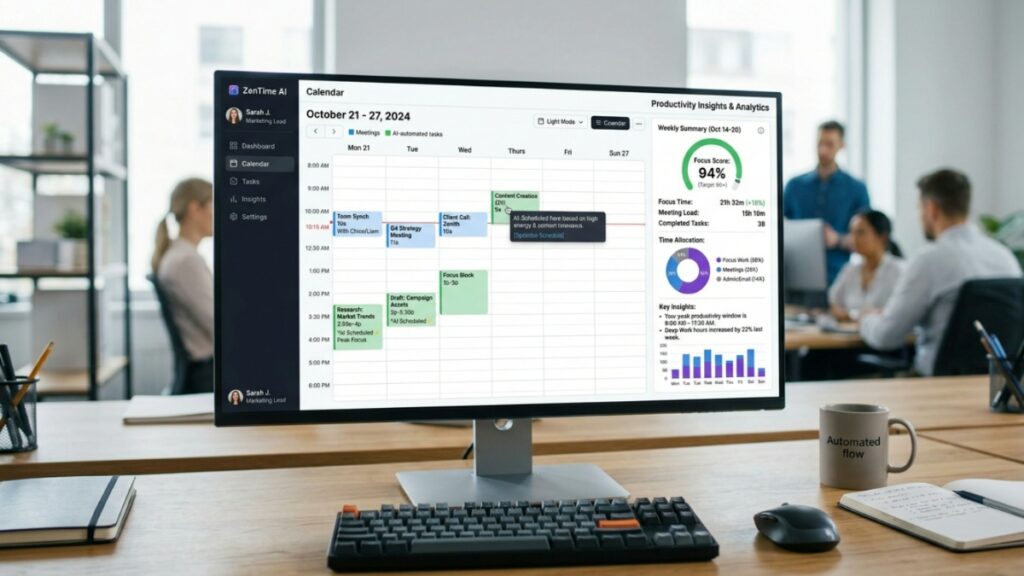
The concept of the “quantified self” has moved into workplace productivity: your schedule is now shaped by real data about how your body and brain perform throughout the day.
The Rise of AI “Superworkers”
McKinsey’s January 2025 research report on “Superagency in the Workplace” identified a growing model: humans augmented by AI who dramatically increase their output and impact. AI handles routine cognitive tasks — data entry, scheduling, initial research, draft communications — while humans focus on strategic thinking, creative problem-solving, and relationship-building.
A real-world example: Repsol’s AI deployment across its organization resulted in employees saving an average of 121 minutes per week, alongside a 16.2% improvement in output quality.
The implication for time management is significant. AI does not just save time on individual tasks. It restructures which tasks humans need to do at all.
From Assistants to Agents
The biggest trend in AI productivity tools in 2026 is the shift from passive assistants to active agents — software that executes tasks independently rather than waiting for prompts. These tools can manage email drafts, update project dashboards, book meetings, and summarize research without step-by-step human direction.
For professionals willing to invest in setup and workflow integration, AI agents represent the most significant time management leverage available today.
Building Your Personal Time Management System
Theory is only useful when it translates into daily practice. Here is a practical framework for building a sustainable time management system from scratch.
Step 1: Audit Your Current Time Use
Before optimizing, understand where your time actually goes. Track every 30-minute block for one to two weeks. Most people are genuinely surprised by what they find.
Common discoveries:
- Meetings that could be emails
- Administrative tasks eating deep-work time
- Commute and transition time that could be used for low-focus tasks
- Energy peaks being wasted on low-value activities
Step 2: Define Your Priorities
List your three to five most important professional goals for the next 90 days. Then ask: what tasks, if done consistently, would most directly advance each of those goals?
These tasks — your “high-leverage activities” — deserve the best slots in your calendar. Morning hours, uninterrupted blocks, your peak energy window.
Step 3: Design Your Ideal Week
Create a template for an ideal week. Not a rigid schedule, but a blueprint: when you do deep work, when you handle communications, when you take meetings, when you plan and review.
Most productivity researchers recommend:
- Deep work: mornings, two to four hours
- Email and communications: mid-morning and mid-afternoon
- Meetings: afternoon when possible
- Weekly review: Friday afternoon or Monday morning
Step 4: Protect Your System
A plan without protection is just a wish. Identify your three biggest time management threats — the recurring interruptions, obligations, or habits that most consistently derail you — and build specific defenses against each.
This might mean closing your email client until 10 a.m., blocking your calendar for a daily focus session, or setting a “do not disturb” window on your phone.
Step 5: Review and Adjust Weekly
The weekly review is the engine that keeps any time management system running. Set aside 30 to 45 minutes at the end of each week to:
- Review what you accomplished
- Capture anything still open
- Plan the following week’s priorities and blocks
- Identify what is not working and adjust

The 30% efficiency gain associated with weekly planning compounds over time. Professionals who maintain a consistent review practice consistently outperform those who do not.
Time Management for Different Work Styles
Not everyone manages time the same way. Here is a brief guide to adapting core principles for different professional contexts.
For Remote and Hybrid Workers
- Create a physical transition ritual to signal the start and end of the workday
- Use time-zone tools if you collaborate across geographies
- Establish clear communication norms with your team: what requires a real-time response, what does not
- Design a dedicated, distraction-minimized workspace
For Managers and Team Leaders
- Audit your team’s meeting load — most teams have more meetings than necessary
- Use asynchronous communication tools for updates that do not require real-time presence
- Model the time management behaviors you want your team to adopt
- Protect your team’s “maker time” — uninterrupted blocks for deep, creative, and strategic work
For Entrepreneurs and Freelancers
- Batch similar tasks together to minimize context-switching costs
- Separate “operator” tasks (email, admin, client management) from “builder” tasks (strategy, creation, growth)
- Use quarterly planning cycles to stay connected to long-term goals while managing daily demands
- Build buffer time into every project — scope always expands
For Students and Lifelong Learners
- Apply the Pomodoro Technique for study sessions
- Use spaced repetition for retention — studying material at increasing intervals over time
- Protect large uninterrupted blocks for deep reading and writing
- Be intentional about how you use “found time” — commutes, waiting rooms, transitions
The Psychology Behind Time Management
Understanding why we struggle with time management is as important as knowing what to do about it.
Present Bias and Temporal Discounting
Humans are wired to overvalue immediate rewards relative to future ones. This is called present bias, and it explains why checking social media feels better in the moment than working on a project that will pay off in three weeks. Awareness of this bias does not eliminate it, but it helps you design systems that work with your psychology rather than against it.
The Planning Fallacy
Research by psychologists Daniel Kahneman and Amos Tversky identified what they called the planning fallacy: the consistent human tendency to underestimate how long tasks will take. Most people plan as if everything will go smoothly.
The practical fix is simple: add 25 to 50% more time than you think a task will require. You will be right far more often.
Parkinson’s Law
Work expands to fill the time available for its completion. If you give yourself a week to write a report, it will take a week. If you give yourself three hours, it will take three hours — and often the quality difference is minimal.
Deliberately constraining time on tasks — using deadlines, time blocks, or even public commitments — activates focus and efficiency that open-ended time frames do not.
Time Management Tools Worth Considering in 2026
You do not need a dozen apps to manage your time well. But the right tool in the right context can make a meaningful difference.
For Task Management and Planning
- Todoist or Things 3 — clean, reliable, and powerful for personal task management
- Notion — flexible enough to serve as a full productivity operating system
- Linear — ideal for teams managing software or product development work
For Time Blocking and Scheduling
- Reclaim AI — automatically schedules tasks around your meetings and protects focus time
- Motion — AI-powered calendar that re-optimizes your schedule in real time
- Google Calendar or Outlook — the foundation; both support time blocking well when used intentionally
For Focus and Deep Work
- Forest — gamifies focus sessions by growing a virtual tree during uninterrupted work
- Freedom or Cold Turkey — blocks distracting websites and apps during focus windows
- Opal — screen time management with scheduling features for mobile
For Team Time Management
- Clockify — simple, accurate time tracking for teams
- Toggl Track — project-based tracking with useful reporting
- Monday.com or Asana — full project management with AI-assisted prioritization
Common Time Management Myths Worth Debunking
Myth: Multitasking makes you more productive. Research from the American Psychological Association confirms that task switching carries measurable cognitive costs — costs that grow with the complexity of the tasks being switched between. What feels like multitasking is actually rapid context-switching, and it is consistently less efficient than single-task focus.
Myth: Working longer hours means getting more done. Time data from distributed teams consistently shows that as hours climb, focus drops, context switching rises, and output per hour declines. Long hours can sustain short-term output at the cost of long-term performance and wellbeing.
Myth: You need to find the perfect system before you start. The average worker experiments with 13 different time management methods throughout their career. Chasing the perfect system is its own form of productive procrastination. A simple system executed consistently outperforms a complex one that is never fully adopted.
Myth: Busy equals productive. Busyness is often a form of avoidance — filling time with low-stakes tasks to avoid the discomfort of high-stakes, difficult work. Genuine productivity is measured by output and outcomes, not by how full your calendar looks.
Conclusion
Time management is not about cramming more tasks into fewer hours. It is about making deliberate choices about where your time and attention go — and building systems that support those choices over the long term.
The data is clear: most people are operating without a real system, losing hours every week to interruptions, email overload, and misaligned priorities. But the same data shows that relatively small, consistent changes — weekly planning, time blocking, protecting your peak energy hours — can deliver a 30% or greater improvement in real-world efficiency.
In 2026, the most effective time managers are not the ones working the hardest. They are the ones who have learned to work with clarity, protect their focus, and leverage the tools — including AI — available to them.
Start simple. Pick one framework from this guide and apply it for 30 days before adding anything else. Track what changes. Adjust what does not work.
Your time is the one resource you cannot earn back. Managing it well may be the highest-leverage skill you ever develop. Share this guide with someone who needs it, and let us know in the comments which method you plan to try first.
Frequently Asked Questions About Time Management
What is time management and why does it matter?
Time management is the practice of planning and consciously controlling how much time you spend on specific activities to maximize effectiveness and productivity. It matters because unstructured use of time consistently leads to lower output, higher stress, and less progress toward meaningful goals — regardless of raw ability or effort.
What is the most effective time management technique?
No single technique works for everyone. Research supports time blocking, the Pomodoro Technique, the Eisenhower Matrix, and weekly planning reviews as consistently effective across different work styles. Most high performers combine elements from multiple approaches rather than following any one system rigidly.
How long does it take to improve time management skills?
Meaningful improvements in daily productivity are often noticeable within two to four weeks of consistent practice. However, building reliable systems that hold up across different contexts typically takes three to six months of intentional refinement.
Can AI really help with time management?
Yes — AI scheduling tools, task prioritization assistants, and intelligent calendar managers can meaningfully reduce administrative overhead and protect focus time. Real-world deployments show measurable weekly time savings, with gains increasing as AI tools become better integrated into existing workflows.
How do you manage time when you have too many priorities?
When everything feels urgent, the most effective step is to stop and explicitly prioritize using a framework like the Eisenhower Matrix. Identify the two or three tasks that will have the greatest impact on your most important goals, and schedule protected time for those first. Everything else gets scheduled, delegated, or deferred.
What is the biggest mistake people make with time management?
Treating to-do lists as a system. A list of tasks without prioritization, time allocation, or a review process is just a record of intentions. The most common failure is confusing capturing work with actually managing it.
How does poor time management affect mental health?
Chronic poor time management is strongly associated with elevated workplace stress, burnout, and reduced sense of personal agency. Research links workload-driven stress — which poor time management amplifies — to 39% of work-related stress among U.S. employees. Conversely, structured time management practices consistently show positive effects on perceived control, reduced anxiety, and overall wellbeing.
Last reviewed: June 2026.
Statistics and research citations reflect the most current available data at the time of publication.