

Most students don’t fail because they’re incapable. They fail — or fall behind, or burn out — because they never learned how to manage the one resource that determines everything else: time. Not money, not talent, not even intelligence. Time.
According to research from the UK’s Higher Education Policy Institute, more than 60% of university students report feeling consistently overwhelmed by their academic workload. Yet when those same students track their actual study hours, a striking pattern emerges: large portions of the day disappear into activities that produce almost no academic output. The problem is rarely a shortage of hours. It is the absence of a deliberate system for using them.
Working closely with students navigating A-Levels, undergraduate degrees, and postgraduate programmes across the UK and US, we’ve observed something consistent: those who develop solid time management habits in their first term outperform equally bright peers by the end of the year — not because they work harder, but because they work with far greater intention. The difference is rarely dramatic; it accumulates quietly over weeks.
This guide walks you through every practical dimension of student time management — from understanding why your brain resists planning, to building a weekly schedule that actually holds, to recovering when everything falls apart. By the end, you will have a complete toolkit that can be applied starting today.
Why Students Struggle with Time Management (And Why It’s Not Your Fault)
Before diving into techniques, it is worth understanding the root causes of poor time management in students — because if you misdiagnose the problem, the solutions won’t stick.
The Planning Fallacy Is Working Against You
Cognitive scientists have a name for the tendency to underestimate how long tasks will take: the planning fallacy. First described by psychologists Daniel Kahneman and Amos Tversky, it affects almost everyone, but students are particularly vulnerable because so many of their tasks are novel. When you have never written a 3,000-word literature review before, you have no reliable reference point for how long it takes. You guess — and you guess optimistically.
In practice, this means students routinely allocate 2 hours for tasks that require 5. Then they scramble, cut corners, or miss deadlines entirely. The solution is not to try harder to estimate accurately. It is to build in buffers deliberately — a strategy covered in detail in the scheduling section below.
Dopamine and the Procrastination Loop
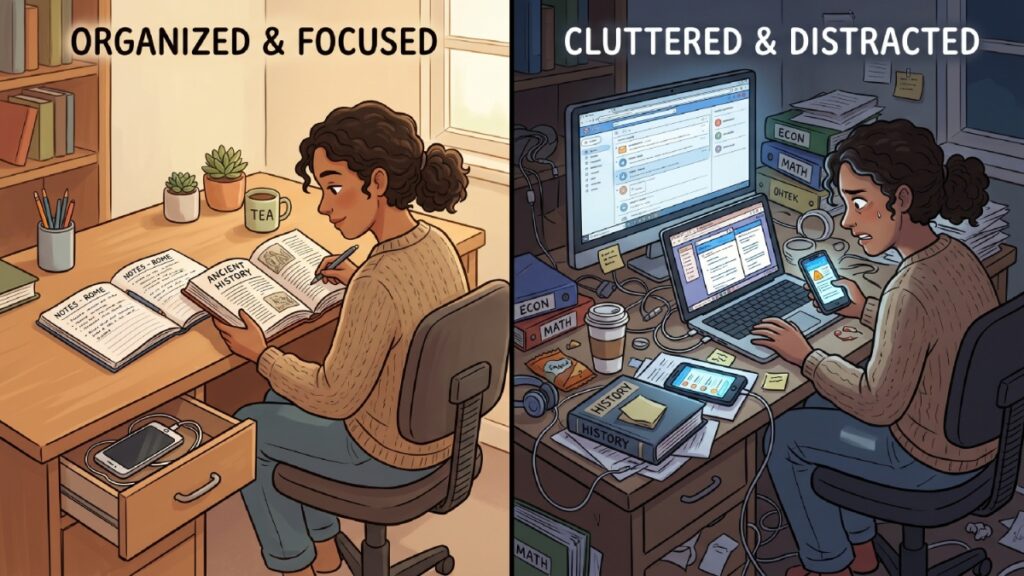
Modern smartphones and social media platforms are engineered to deliver micro-doses of dopamine on demand. Studying, by contrast, requires sustained effort before any reward appears. From your brain’s perspective, scrolling Instagram is always going to feel more immediately satisfying than reading a textbook — that’s not a character flaw, it’s biology.
Students who understand this dynamic stop blaming themselves for distraction and start engineering their environment instead. This distinction — between willpower-based approaches and system-based approaches — is central to effective student time management.
The Myth of Multitasking
Research from Stanford University found that heavy multitaskers actually performed worse on tasks requiring focus than those who focused on one thing at a time. Yet university environments actively encourage a form of multitasking: students sit in lectures while reading emails, study in noisy common rooms, and try to write essays with their phone face-up on the desk.
The academic cost is real. According to a University of London study, task-switching can temporarily reduce a student’s effective IQ by up to 15 points — the equivalent of missing a full night’s sleep. Single-tasking is not just a productivity tip. It is one of the most evidence-backed changes a student can make.
Auditing Your Time: The Essential First Step
No time management system works without first knowing where your time actually goes. Most students are genuinely surprised — and sometimes unsettled — by what a time audit reveals.
How to Conduct a 7-Day Time Audit
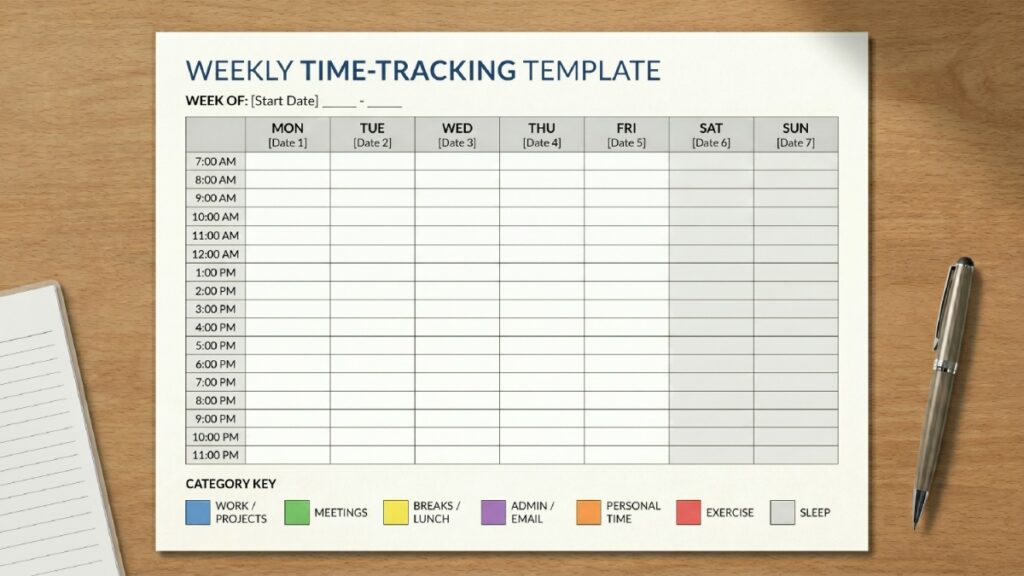
The process is straightforward and costs nothing. For one full week, record your activities in 30-minute blocks. You do not need a special app; a notes file or printed grid works perfectly well. At the end of each day, spend 5 minutes categorising what you did:
- Scheduled academic work — lectures, seminars, labs, timetabled study sessions
- Unscheduled study — reading, essay writing, revision, problem sets done outside of timetabled time
- Maintenance activities — sleep, eating, hygiene, commuting
- Social and leisure — time with friends, exercise, hobbies, entertainment
- Unaccounted time — anything that doesn’t clearly fit a category (this is usually where the real data is)
After seven days, total each category. Most students discover that category five — unaccounted time — is far larger than expected, often between 2 and 4 hours per day. Even recovering half of that time represents an additional 7 to 14 hours of weekly study capacity.
Practical Tip: Don’t try to fix anything during the audit week. Just observe. Students who try to improve simultaneously often distort the data and miss the patterns.
What to Do With the Data
Once you have the numbers, look for three things:
- Time sinks — activities that consumed significant time without corresponding value (passive scrolling, aimless browsing, half-watching TV while “studying”)
- Energy patterns — times of day when you were genuinely productive versus times when you were present but accomplishing little
- Scheduling gaps — stretches between commitments that were long enough to use productively but consistently went to waste
This information shapes everything that comes next. A student who does their best thinking between 9am and noon should structure their most demanding work in that window. A student who has 90-minute gaps between lectures three days a week has a ready-made study structure waiting to be claimed.
Building a Weekly Schedule That Actually Works
With audit data in hand, you are ready to build a schedule. The key word is build — a functional student schedule is engineered, not wished for.
The Fixed-Flexible Framework
Most scheduling advice for students fails because it treats every hour as equally negotiable. In reality, your week has two distinct types of time:
Fixed time is non-negotiable: lectures, seminars, work shifts, sports training, medical appointments. These anchor your week.
Flexible time is everything else — but here is where most students go wrong. They leave flexible time genuinely flexible, which in practice means it gets consumed by whatever is most immediately compelling. The fix is to assign flexible time in advance, treating it as if it were fixed.
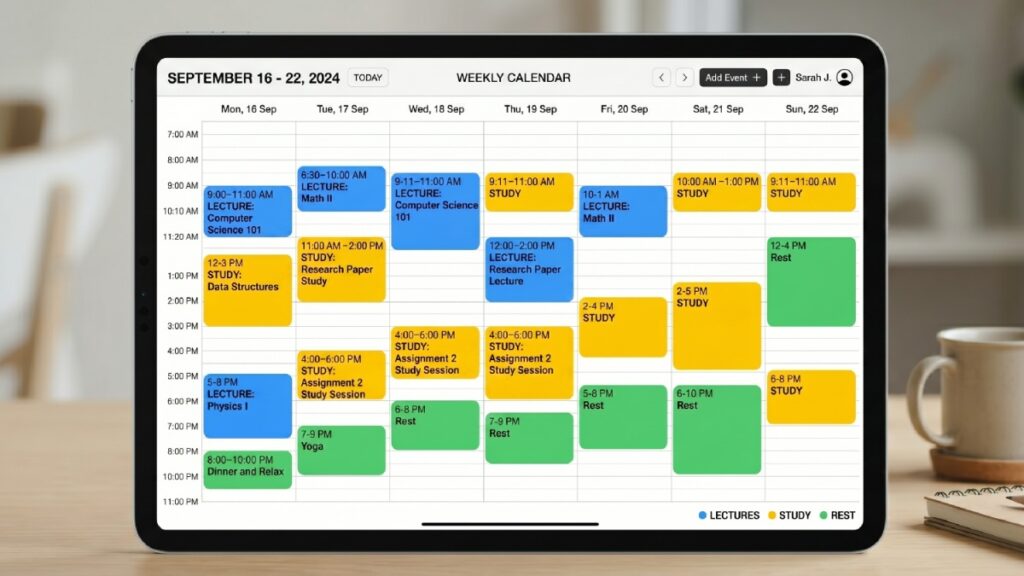
A practical approach: at the end of each week (Sunday evenings work well for most students), spend 20 minutes assigning the coming week’s flexible time in broad categories. Not “study from 2pm to 5pm on Tuesday” necessarily, but “Tuesday afternoon = economics assignment.” This is specific enough to create intention but loose enough to accommodate reality.
The 50-Minute Study Block
Neuroscience research on attention and memory consolidation consistently supports shorter, focused study sessions over marathon sessions. A widely adopted format — used in schools and universities across the UK — structures study time in 50-minute focused blocks followed by a genuine 10-minute break.
The break is not optional and it is not a reward. It is when much of the learning happens. During rest, your brain engages default mode network processing — consolidating what you just studied into long-term memory. Students who skip breaks in an effort to cover more material often retain less than those who studied for fewer minutes but rested between blocks.
Important: A 10-minute break means away from screens. Checking your phone activates the same attentional systems you just worked hard to rest. Walk around, make tea, stare out the window. That is a break. Phone-scrolling is not.
Sample Weekly Schedule Structure
| Time Slot | Mon | Tue | Wed | Thu | Fri |
|---|---|---|---|---|---|
| 9:00–10:30 | Deep work (essay/problem sets) | Lecture | Deep work | Lecture | Deep work |
| 10:30–11:00 | Break + admin | Break | Break + admin | Break | Break |
| 11:00–12:30 | Lecture | Deep work | Seminar | Deep work | Reading |
| 12:30–13:30 | Lunch (no studying) | Lunch | Lunch | Lunch | Lunch |
| 13:30–15:00 | Reading/notes | Lab | Reading/notes | Seminar | Flexible |
| 15:00–17:00 | Exercise / social | Admin tasks | Exercise | Assignment work | Social |
| Evening | Light review only | Light review | Light review | Light review | Free |
This is a template, not a prescription. The point is the structure: protected deep work blocks in the morning, lighter tasks in the afternoon, genuine rest in the evenings at least two nights per week.
Prioritisation Systems That Work for Students
Having time is one thing. Knowing what to do with it is another. Students typically face a constant stream of competing demands — lectures to catch up on, assignments due at different times, reading lists that never seem to shrink. Without a clear prioritisation system, it is easy to spend all your time on whatever feels most urgent rather than what actually matters most.
The Two-Variable Matrix
One of the most practical frameworks for student prioritisation uses two variables: urgency and importance. Tasks fall into four quadrants:
- High urgency + high importance: Do immediately. An essay due tomorrow that carries significant grade weight belongs here.
- High importance + low urgency: Schedule deliberately. Long-term revision, portfolio work, thesis research. These tasks are neglected most dangerously because they never feel pressing until they do.
- High urgency + low importance: Batch or delegate. Admin emails, some group project coordination, bureaucratic requirements.
- Low urgency + low importance: Eliminate or significantly limit. This is where a surprising amount of student time goes.
Best Practice: Most students spend the majority of their time in the top-left quadrant (urgent + important) and almost no time in the top-right (important + not yet urgent). Deliberately scheduling important-but-not-urgent tasks is the single highest-leverage change most students can make.
The MIT Method: Three Tasks Before Everything Else
A simpler complement to matrix thinking is the MIT (Most Important Tasks) method. Each morning — before opening email, before checking messages — identify three tasks that, if completed, would make the day genuinely productive. Not ten. Not five. Three.
This forces genuine prioritisation rather than the comfortable illusion of productivity that comes from crossing off easy items. A student who completes their three MITs for the day has moved meaningfully forward, regardless of what else happened.
Managing Deadlines Without the Panic
Deadline panic is almost universal among students, but it is also largely preventable with a small number of consistent habits.
The Reverse Calendar Method
Working backwards from a deadline is more effective than planning forward. Starting from your submission date, count backwards and assign the following milestones:
- Submission — the actual deadline
- Final review — 48 hours before submission (proofreading, formatting, checking references)
- Draft completion — 5–7 days before submission
- Outline and research done — 10–14 days before submission
- First reading/research begun — 3 weeks before submission
This makes the work feel manageable and, crucially, makes it visible far enough in advance to actually plan around it. Students who use this method consistently report that the panic of the final 48 hours largely disappears — not because the work is less demanding, but because it was distributed more sensibly.
The Semester Overview Map
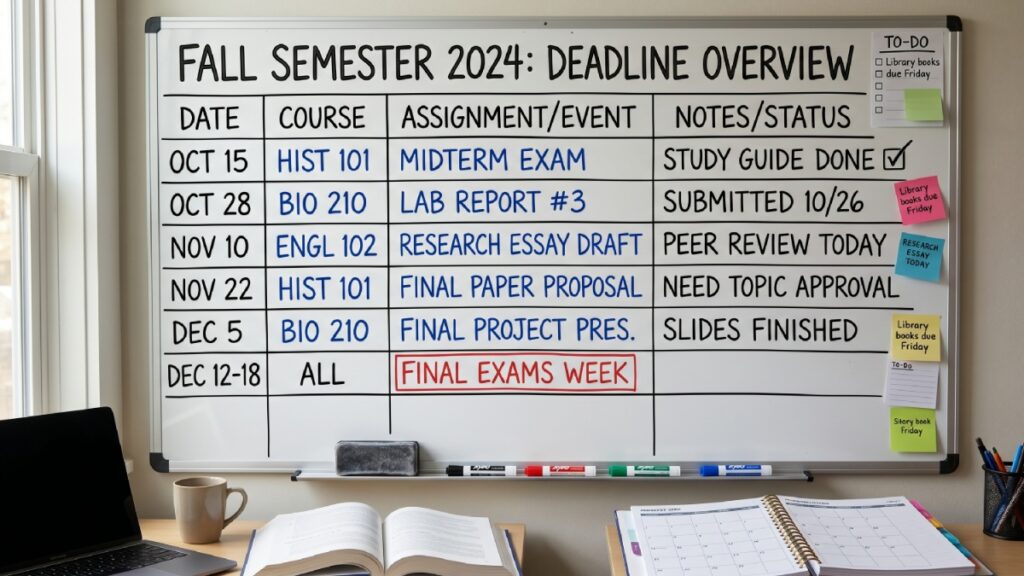
At the start of each term, spend 45 minutes creating a semester-level overview. List every assessed piece of work, its weight, and its deadline. Then look for collision weeks — weeks when multiple deadlines cluster together — and begin planning how to pull work forward to avoid the crunch.
This is a 45-minute investment that typically saves 20 or more hours of crisis management over the course of a 12-week term.
| Assignment | Weight | Deadline | Begin Work By | Draft Due |
|---|---|---|---|---|
| Economics Essay | 30% | Week 8 | Week 5 | Week 7 |
| Statistics Problem Set | 20% | Week 6 | Week 4 | Week 5 |
| Group Presentation | 25% | Week 10 | Week 7 | Week 9 |
| Exam (History) | 40% | Week 12 | Week 8 | n/a |
Study Techniques That Make Time Management More Effective
How you study matters as much as when you study. A student who sits at a desk for 3 hours using passive review techniques (re-reading, highlighting) will often retain less than a student who studies for 90 minutes using active retrieval methods.
Active Recall and Spaced Repetition
Active recall — testing yourself on material rather than re-reading it — is consistently rated among the most effective learning strategies in educational psychology research. A 2013 meta-analysis published in Psychological Science in the Public Interest reviewed 250 learning studies and found that practice testing produced far larger gains than any passive study method.
The complementary technique, spaced repetition, involves revisiting material at increasing intervals (for example: after 1 day, then 3 days, then 7 days, then 21 days). Spaced repetition tools such as Anki are widely used by medical students and language learners precisely because they dramatically reduce the total study time needed to retain information long-term.
For students managing a heavy workload, combining these two methods means covering more material in less time — which is the most direct application of time management principles to academic performance.
The Feynman Technique for Difficult Material
For subjects where you consistently feel confused or stuck, the Feynman Technique offers a reliable path forward. It works like this:
- Take a blank sheet of paper and write the concept at the top
- Explain the concept in plain language, as if teaching it to someone with no background
- Identify every gap or confusion in your explanation — these are your actual learning gaps
- Return to your source material only to close those specific gaps
- Repeat until your explanation is complete and simple
Students who use this technique regularly report that it consistently surfaces misunderstandings that passive re-reading never would have caught. It is also faster: a thorough Feynman session on a difficult concept often takes 30–40 minutes and produces deeper understanding than several hours of highlighting.
Dealing with Digital Distractions and Protecting Focus
For most students in 2026, digital distraction is the single largest threat to effective time management. Addressing it honestly — rather than assuming willpower will be sufficient — is essential.
Environment Design Over Willpower
The most consistent finding across behavioural science research on habit formation is that environment shapes behaviour more reliably than motivation. Put differently: if your phone is on your desk while you study, you will check it, regardless of your intentions. If it is in another room, you mostly won’t.
Effective students don’t rely on resolve. They restructure their physical and digital environment to make focus the path of least resistance:
- Study in locations where social media use feels socially awkward (libraries, study rooms, academic cafes)
- Use browser extensions that block distracting sites during study sessions (Cold Turkey and Freedom are widely used in UK universities)
- Establish a consistent pre-study ritual — making tea, tidying the desk, turning off notifications — that signals to your brain that focused work is beginning
- Keep your phone physically out of reach during study blocks, not just face-down
Practical Tip: Research from the University of Texas found that even having a smartphone on a desk — turned off, face-down — measurably reduced available cognitive capacity compared to having it in another room. Out of sight genuinely means out of mind.
The Strategic Use of “Do Not Disturb”
University life involves significant social obligations, and blanket digital withdrawal creates its own problems. A more sustainable approach is strategic rather than absolute. During designated deep work blocks, all notifications off, phone away. During transitions and breaks, fully available. This two-state model prevents the resentment and social friction that comes from trying to stay offline entirely.
Managing Energy Alongside Time
Time management for students that ignores energy management is incomplete. You can have 8 hours blocked for study, but if your energy is depleted, those hours will produce far less than 4 well-rested, well-fed, focused hours.
Sleep Is a Non-Negotiable
Among students, sleep deprivation is sometimes worn as a badge of commitment. The evidence argues strongly against this culture. Research published in the journal Sleep found that students who slept fewer than 7 hours per night performed significantly worse on assessments than those who slept 8 hours, even when controlling for total study time.
More specifically, sleep is when memory consolidation occurs. A student who studies until 2am and sleeps 5 hours has, in terms of retention, likely achieved less than one who studied until midnight and slept 8 hours. This is not an argument for laziness; it is an argument for treating sleep as part of your academic strategy rather than sacrificing it in the name of study hours.
Exercise, Nutrition, and Cognitive Performance
Regular aerobic exercise has been shown in multiple studies to improve attention, working memory, and cognitive processing speed — all of which directly affect how efficiently you can study. A 20-minute brisk walk before a study session is not time wasted; it is time invested in making the subsequent study session more effective.
Similarly, eating regular meals with adequate protein and complex carbohydrates stabilises blood glucose, which directly affects concentration and mood. Students who skip breakfast and eat erratically often experience significant dips in focus in the late morning — dips that get attributed to poor motivation but are partly physiological.

When Everything Falls Apart: Recovering Without Losing the Week
Even with excellent systems, things go wrong. An unexpected illness, a family crisis, a relationship problem, or simply a week of unusually poor motivation can derail the best-laid plans. The difference between students who recover quickly and those who spiral into prolonged underperformance is usually not resilience — it is the presence or absence of a recovery protocol.
The 48-Hour Reset
When a week has genuinely collapsed — when barely anything on the plan happened — the worst response is guilt-driven overwork the following week. Trying to make up 20 missed hours by cramming them into the weekend typically results in exhaustion, poor quality work, and setting the next week up badly.
A more effective approach: accept that some work is simply lost, identify the two or three most urgent items that absolutely must be done before the week is out, do those, and then rebuild the normal schedule from the following Monday. This requires a certain acceptance of imperfection that many students find difficult but which becomes easier with practice.
Self-Compassion Is Not Laziness
Research from Dr. Kristin Neff at the University of Texas, Austin — one of the world’s leading researchers on self-compassion — consistently shows that students who treat themselves with kindness after setbacks are more likely to improve performance on subsequent tasks, not less. The inner critic that says “I’m terrible at managing my time” is not motivating. It is demoralising, and demoralised students study less effectively.
A more accurate and productive internal script: “This week didn’t go as planned. What one thing can I do differently next week?” That question is answerable. It is also forward-looking — and forward-looking thinking is what good time management fundamentally requires.
Conclusion
Effective time management for students is not about squeezing every moment of every day into productive output. It is about building a deliberate relationship with time — one where your hours serve your actual priorities, your energy is protected rather than burned through, and your approach to work is sustainable across a full academic year.
The most important steps are also the most concrete: run a time audit to understand where your hours actually go, build a fixed-flexible weekly structure that protects your deep work, use a semester overview to anticipate and prevent deadline collisions, and design your environment so that focus is the easier option rather than the effortful one.
No single technique from this guide will transform your academic life overnight. But a combination of even three or four of these practices, applied consistently over the next six weeks, will produce a measurable difference in both your output and your stress levels.
Start small. Pick one strategy from this guide — a time audit, the 50-minute block, a semester map — and run with it for a week before adding anything else. Progress in time management, like progress in most things, compounds quietly before it compounds dramatically.
Frequently Asked Questions
How much time should a university student spend studying each week?
Most universities recommend a total of around 35 to 40 hours per week of academic engagement, including contact hours (lectures, seminars, labs) and independent study. A student with 12 hours of contact time should therefore aim for approximately 23 to 28 hours of additional study. This varies by subject — STEM programmes with heavy lab requirements often demand more — and by level: final-year and postgraduate study typically requires 45+ hours per week during peak periods. The quality and focus of those hours matters as much as the quantity.
What is the most effective study schedule for students with part-time jobs?
Students who work part-time need to treat their work shifts as fixed anchors and build study blocks around them, exactly as they would with lectures. The key is protecting at least two or three mornings per week for demanding academic work, since evenings after shifts tend to produce lower-quality study. Research into student employment suggests that up to 15 hours of part-time work per week can be managed without significant academic impact, provided that scheduling is deliberate and sleep is consistently prioritised.
Is it better to study the same subject for several hours in a row or to spread it across shorter sessions?
For most subjects, distributed practice across shorter, spaced sessions consistently outperforms massed practice (studying the same topic for several hours at once). Spaced sessions of 50 to 90 minutes, returning to the same material 24 to 48 hours later, produce better long-term retention. The exception is complex problem-solving tasks — programming, mathematics, extended writing — where you need extended time to hold a large mental model in working memory. For those tasks, a 2-hour block is often appropriate.
How do I manage time during exam revision periods?
Revision requires a separate approach to normal term-time scheduling. The most effective structure allocates 3 to 4 distinct subjects per day in rotation (rather than spending entire days on a single subject), uses active recall — past papers, flashcards, practise questions — rather than passive re-reading, and reserves at least one complete rest day per week during revision. Students who revise seven days straight without a day off typically hit a performance plateau within 10 to 14 days. Planned rest is not a luxury during exams; it is part of the revision strategy.
What should I do when I feel too overwhelmed to even start?
This feeling — task paralysis — is extremely common among students and is usually a sign that the task feels too large rather than too difficult. The fix is to reduce the task to the smallest possible starting action: not “write the essay” but “open a document and write the first sentence.” Most students find that once they start, momentum builds and the paralysis dissolves. If the feeling persists over several days alongside low mood, changes in sleep, or withdrawal from social activities, it is worth speaking with your university’s student support service — these feelings sometimes signal something beyond ordinary overwhelm.
Does time management look different for postgraduate students versus undergraduates?
Significantly. Undergraduate time management is largely structured around imposed deadlines and contact hours. Postgraduate study — particularly PhD research — requires students to generate their own structure in the near-complete absence of external scheduling. This shift catches many students off guard. Postgraduates benefit from creating artificial deadlines with their supervisors, using accountability partnerships, and treating their research like a 9-to-5 job with clear start and finish times, rather than something to be worked on whenever motivation strikes.
Are time management apps actually useful for students, or are they just another distraction?
They can be both, depending on how they are used. Apps that reduce friction — digital calendars, simple to-do lists, focus timers — add genuine value. Apps that create more complexity than they solve, or that require significant daily maintenance, often become procrastination tools in disguise. Our recommendation: start with a paper planner or a single calendar app for the first four weeks of implementing a new system. Introduce digital tools only once the underlying habits are established. The system should serve the student; the student should not become a servant to the system.